
Industry Insights
Why Engineering Changes Break Down Between Departments
The engineering is often the easy part. The handoffs are where things get complicated.
Published on September 18th, 2026
An engineering change can look deceptively simple. Change a component. Update a drawing. Get an approval. Release the new revision.
But the engineering itself is often only one part of the process. The real complexity begins when the change leaves Engineering.
Quality may need to review it. Purchasing may need to understand the impact on materials or suppliers. Operations needs to prepare for the change. Production needs updated drawings or work instructions. An outside vendor may need to modify a component, tooling, packaging, or another part of the process.
What started as an engineering decision can quickly become a cross-functional business process, with every additional participant creating another handoff.
A Change Can Travel a Long Way
Consider what happens when an engineer decides that a component needs to change.
Engineering creates the change request and updates the relevant specifications. Quality reviews the potential impact. Purchasing discovers that the existing supplier has inventory of the old component. The supplier needs the revised specification and must confirm when it can begin shipping the new version.
Meanwhile, Operations needs to determine when the change can enter production. Work instructions may need to be revised. A new drawing needs to be released and the previous version retired. Production supervisors need to know when employees should start working from the new information.
Depending on the change, customers, contract manufacturers, equipment vendors, or other external partners may also need to be involved.
The challenge isn’t necessarily determining what needs to change. It’s coordinating everything that has to happen because of the change.
Approval Isn’t the Finish Line
One of the biggest weaknesses in engineering change processes is treating approval as completion. Getting the required signatures doesn’t mean the change has actually happened.
The drawing may still need to be released. A supplier may need to change its process. Old inventory may need to be consumed, reworked, or quarantined. Production documentation may need updating. Employees may need to be notified.
There are really two different questions:
Has the change been approved?
Has the change been implemented?
A strong engineering change process needs visibility all the way through implementation, not just through approval.
Document Control and Change Control Are Connected
Engineering changes almost always create another challenge: controlling the documents affected by the change.
A single change may affect drawings, specifications, bills of materials, work instructions, inspection procedures, supplier documentation, or other controlled information.
The new versions need to be reviewed and released. Previous versions may need to be retired. The correct people need access to the new information. In some cases, external suppliers or partners need it too.
This is why engineering change management and document control are so closely connected. A change isn’t truly under control if the organization approves it but people continue working from the old information.
Operational Truth
An engineering change isn’t complete when it’s approved. It’s complete when everyone affected is working from the new reality.
That includes Engineering, Quality, Purchasing, Operations, and Production. When the process extends outside the organization, it also includes the suppliers and vendors responsible for carrying out their part of the change.
One Change. One Visible Process.
The answer isn’t more meetings or better email discipline. It’s creating one visible process around the change.
Everyone involved should be able to understand what has happened, what still needs to happen, who owns the next step, and which documents are current.
Engineering should be able to see that Quality has completed its review. Purchasing should know when it needs to involve a supplier. Operations should know when the change is ready for implementation. Production should know exactly which version to use. Management shouldn’t need a status meeting just to figure out where everything stands.
Start With the Handoffs
If your engineering change process feels harder than it should, don’t start by looking at what happens inside Engineering. Follow one change from beginning to end.
Look at every time it moves from one person, department, system, or outside vendor to another. Those transitions will usually tell you where the problems are.
That’s where information gets lost, approvals stall, ownership becomes unclear, and outdated versions remain in circulation.
Klyck helps manufacturers bring those handoffs into one controlled workflow, connecting requests, reviews, approvals, documents, internal teams, and external participants from the initial change through implementation.
Because the hardest part of an engineering change often isn’t deciding what needs to change.
It’s making sure everyone affected actually changes with it.
Related Operational
Insights

Maximizing Content Impact for Sales and Marketing Alignment
Klyck.io Blog Articles, news, tips, tricks and trendsMaximizing Content Impact for Sales and Marketing Alignment Picture this: You've got a killer marketing campaign being created - compelling messaging, stunning visuals, the works. But if that content isn't aligned...
Enhancing Communication through Unified Knowledge Management
Klyck.io Blog Articles, news, tips, tricks and trendsEnhancing Communication through Unified Knowledge Management In sales and marketing, collaboration is key in driving business growth. In fact, 87% of sales and marketing leaders agree that collaboration between...
Empowering Teams through Joint Training Programs and Continuous Alignment
Klyck.io Blog Articles, news, tips, tricks and trendsEmpowering Teams through Joint Training Programs and Continuous Alignment Are your sales and marketing teams coming together - not just for meetings, but for joint training programs that empower how they work...

Top 5 Knowledge Management Tips
Klyck.io Blog Articles, news, tips, tricks and trendsTop 5 Best Knowledge Management Tips If you are a manager or a business owner, you know how difficult it is to homogeneously communicate internal knowledge to the rest of the company. Especially when you have a team...
How Knowledge Management Can Help You and Your Team
Klyck.io Blog Articles, news, tips, tricks and trendsHow Knowledge Management Can Help You and Your Team As an organization grows and evolves, it is bound to develop internal knowledge - an invaluable source of information for the company. In order to use this...

Rock Your Virtual Meetings: Top Backgrounds for the Holidays in 2023
Klyck.io Blog Articles, news, tips, tricks and trendsRock Your Virtual Meetings: Top Backgrounds for the Holidays in 2023 The 2023 Holiday season is in full swing so get ready to make your virtual sales calls merry and bright. With remote sales still happening around...

The Ultimate Guide to Knowledge Management
Klyck.io Blog Articles, news, tips, tricks and trendsThe Ultimate Guide to Knowledge Management In today's rapidly changing business landscape, knowledge management has become a crucial aspect of organizational success. From small businesses to large corporations, the...

The Ultimate Guide to Sales Enablement
Klyck.io Blog Articles, news, tips, tricks and trendsThe Ultimate Guide to Sales Enablement Sales enablement is more than just a buzzword in today's digital age. It's a crucial process that ensures your sales team has all the tools, resources, and content they need to...
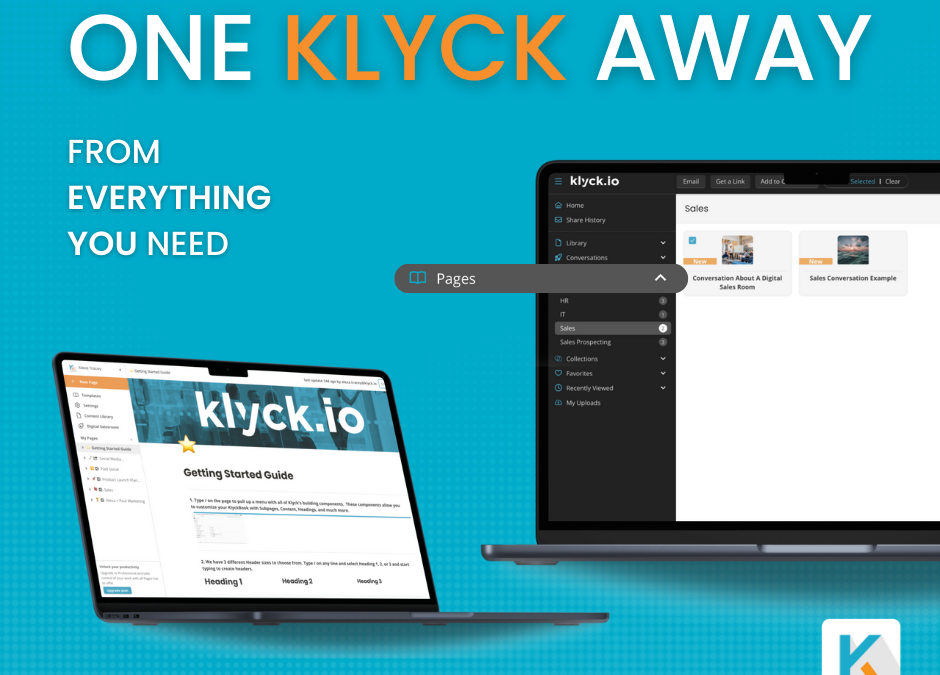
Elevating Sales Efficiency: Introducing the Powerful Integration of Klyck App + Pages
Klyck.io Blog Articles, news, tips, tricks and trends Elevating Sales Efficiency: Integrating Klyck App + Pages At Klyck, we are excited to introduce our groundbreaking integration between our two products, Klyck App and Pages, seamlessly combining content...